|

|
| |
|
|
| |
|
ICY Dock Case study - MLE NVMe FFRAID Recorder
|
| |
| |
|
Missing Link Electronics (MLE) is a Silicon-Valley-based technology company with offices in Germany. For over a decade, MLE has demonstrated its expertise in high-speed connectivity and high-bandwidth multi-gigabit data storage through advanced use of heterogeneous processing with FPGAs, and has been involved in enabling key innovators across the automotive, industrial, test and measurement sectors to accelerate development and deliver next-generation performance.
|
| |
| |
|
|
|
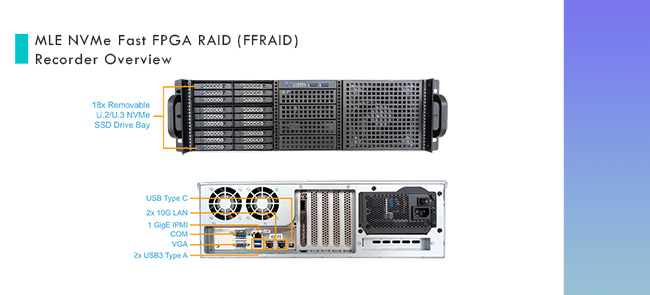
MLE NVMe Fast FPGA RAID (FFRAID) Recorder Overview
|
| |
 |
| |
|
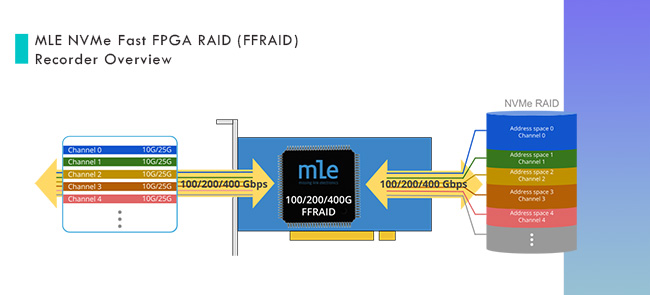
The MLE NVMe FFRAID Recorder is a high-speed, FPGA-based system designed for loss-less, gapless recording at 100, 200, or 400 Gbps. Powered by MLE's proprietary NVMe Fast FPGA RAID (FFRAID) technology, it delivers real-time processing and high-throughput NVMe storage. The system supports up to 18 x U.2/U.3 NVMe SSDs with each channel backed by a dedicated RAID engine and storage path, ensuring consistent, deterministic performance. Multiple units can be cascaded via IEEE time synchronization to extend bandwidth and/or recording duration.
|
 |
| |
|
Unlike typical Network-Attached-Storage (NAS) systems, the MLE NVMe FFRAID Recorder can not only achieve high-speed data storage but also support advanced recording functions:
|
| |
MLE NVMe FFRAID |
Typical NAS system |
| Data Rate |
100 to 400 Gbps |
Limited to < 80 Gbps |
High-accuracy IEEE time
synchronization |
Yes |
No |
| Recording Capability |
Highly optimized to store high-speed data to NVMe storage |
File system based |
| Add-on Capability |
- On-the-fly data decimation
- Indexing and adding metadata
- Transparent data proxy
|
None |
| Storage Location |
RAID of NVMe SSDs |
RAID of NVMe SSDs |
| Remote Management |
Yes, via host Linux |
Yes |
| Front-End |
Adaptable, channel-based, high-speed I/O |
Network only |
| SSD Security |
Self-encryption TCG OPAL |
Self-encryption TCG OPAL |
| RAID compatibility |
Open-source Linux |
Proprietary or open-source Linux |
|
| |
|
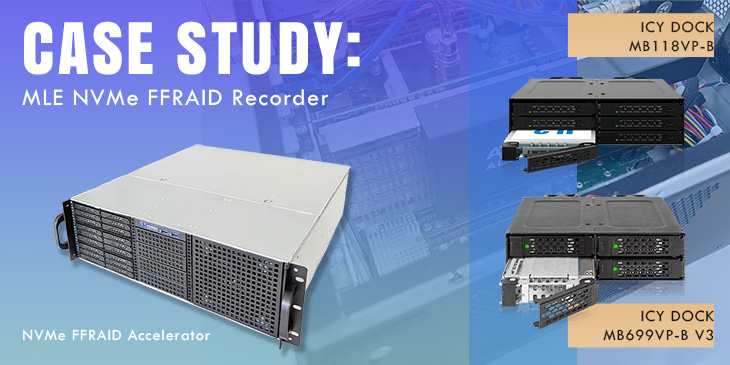
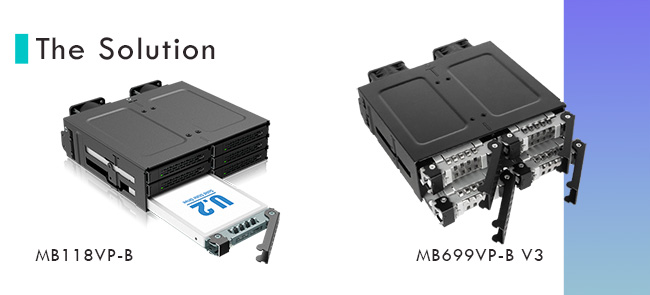
To meet its demanding storage and serviceability requirements, the system integrates the ICY DOCK ToughArmor MB118VP-B, a rugged, front-accessible 6-bay PCIe 4.0 NVMe enclosure optimized for continuous high-bandwidth operation, or the ICY DOCK ToughArmor MB699VP-B V3, a similar 4-bay enclosure variant suited for more compact deployment needs.
|
| |
|
NVMe FFRAID Recorder Highlights:
- High-Speed Recording: Loss-less, gapless capture up to 400 Gbps
- High-Capacity, Secure Modular Storage: Standard configuration of up to 18 NVMe SSDs, with supports for self-encrypting drives (SEDs)
- Scalable: Easily cascade with multiple recorders to extend bandwidth or recording time
- Adaptable Signal Front-Ends: Flexible "mix & match" support for different I/O standards
- Advanced Data-in-Motion Processing: Supports Start—Pause—Stop recording, Data Proxy, data decimation, indexing and metadata generation, as well as Simplex, Half-Duplex, and Full-Duplex Record & Replay modes
- Open Integration: Compatible with Linux Software-RAID , Linux-compatible, with remote user interface RPC API support
- High-Performance Hardware: PCIe Gen4/5 FPGA hardware, rich connectivity
- Versatile Deployment: Supports Bench-top, 19"s Rackmounts, and SWaPC Embedded designs
|
| |
|
NVMe FFRAID Recorder Applications:
- Autonomous Vehicle Path Record & Replay — ideal for capturing high-speed sensor and camera data in automotive systems.
- Automotive / Medical / Industrial Test Equipment — supports continuous high-throughput data collection for analysis and validation.
- High-speed Radar / LiDAR / Camera Data Acquisition & Storage — optimized for defense and edge environments requiring reliable, loss-less capture.
- Deep Network Packet Capture — enables sustained, gap-free recording of Ethernet, IPv4, and TCP/UDP traffic in data-center or network-analysis deployments.
|
| |
| |
|
The Challenge
|
| |
|
To sustain hundreds of gigabits per second of continuous recording, MLE needed a storage enclosure that was PCIe 4.0-capable, thermally stable, and field-serviceable, while maintaining signal integrity and durability in a compact rackmount environment.
|
| |
| |
|
|
|
The Solution — ICY DOCK MB118VP-B & MB699VP-B V3
|
| |
 |
| |
|
- MB118VP-B (x6-bay): Provides six U.2/U.3 NVMe bays, each supporting 7mm drives at PCIe 4.0 x4 (64 Gb/s) speeds. The rugged metal design, dual 40mm cooling fans, and hot-swappable trays deliver density, accessibility, and thermal reliability for sustained workloads.
- MB699VP-B V3 (x4-bay): Offers four U.2/U.3 NVMe bays, each supporting 15mm drives with the same PCIe 4.0 x4 support, rugged construction, and hot-swappable trays, ideal for compact or specialized deployments.
Both enclosures allow flexible integration of high-performance SSDs with any mainboard, enabling deployment-ready NVMe FFRAID systems.
|
| |
| |
|
The Result
|
| |
|
By integrating either the MB118VP-B (x6-bay) or MB699VP-B V3 (x4-bay), MLE's NVMe FFRAID Recorder achieved:
- Sustained full throughput at up to 400 Gbps
- Quick front-access drive serviceability
- Stable thermal performance under heavy I/O workloads
- Compact, rugged deployment within rack-mounted systems
|
| |
| |
Customer Feedback:
"Off-the-shelf 19" server enclosures with NVMe-capable U.2/U.3 backplanes are typically sold only in combination with specific mainboards. However, to implement our high-bandwidth versions of NVMe FFRAID, we need control over the specific mainboard used and its PCIe connectivity.
The ICY DOCK U.2/U.3 cages (MB118VP-B and MB699VP-B V3) allow us to freely combine any mainboard with swappable high-performance SSDs."
— Yi-Ying Li (Director of Tech. Solutions), Missing Link Electronics (MLE)
|
| |
| |
|
Conclusion
|
 |
| |
|
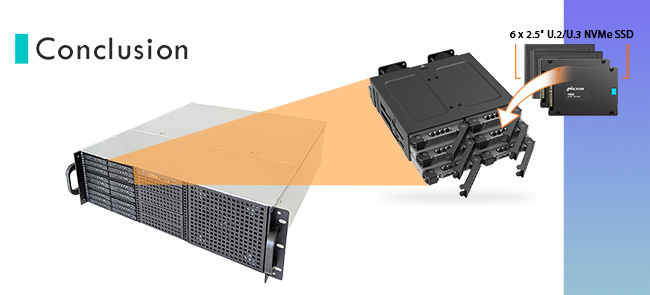
By combining MLE's FPGA-accelerated recording technology with ICY DOCK's MB118VP-B (x6) or MB699VP-B V3 (x4) SSD enclosures, the NVMe FFRAID Recorder achieves exceptional connectivity, reliability, and modularity for high-speed data acquisition. This partnership underscores how precise enclosure engineering can empower cutting-edge FPGA systems to perform at their full potential — maintaining loss-less, gapless capture at up to 400 Gbps.
|
| |
| |